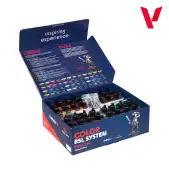
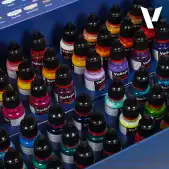
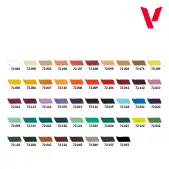
BSL stands for Base Shade Light. This workflow organizes paints into chromatic families (triads). Each family provides three perfectly matching tones to create seamless volumetric depth with minimal effort.
As I've started to use more of the Vallejo Game Color range, I've found that the paints are designed to work together in a way that makes it easy to create smooth transitions and highlights. This workflow is based on the idea of using a triad of colors for each chromatic family, which allows for a consistent and harmonious look across the miniature.
Base: Applying the foundational primary color to the miniature. Shade: Applying a darker wash or paint to settle in the recesses to create shadow. Highlight: Applying a lighter shade to the raised edges to simulate light reflecting off the surface.
Below are some examples of how to use the BSL workflow for different colors and materials. Each example includes a list of paints used and a step-by-step guide on how to apply them.
White
Warm White
- Base with Green Grey.
- Highlight with Pastel Green.
- Enhance the highlight with a 50:50 mix of Pastel Green and Off White.
- Further enhance the highlight with Off White.
- Add an extreme highlight with White.
- Glaze transitions with Pastel Green.
Cold White
- Base with Wolf Grey.
- Shade with Steel Grey.
- Highlight with Dead White.
- Glaze midtones with a 50:50 mix of Wolf Grey and Dead White.
White Skin
- Base with Elfic Flesh.
- Shade with Steel Grey.
- Highlight with Off White.
- When painting scales add Sombre Grey as a texture to the plates.
White Fur
- Base with Bone White.
- Add shadow with Khaki then mix the two together to blend the transitions.
- Highlight with Off White.
- Add texture with Dead White.
Skin
Base Skin
- Base with Elf Skin Tone.
- Shade with Barbarian Skin.
- Blend the transtions with a 50:50 mix of the previous two colors.
- Highlight with Skin Tone.
- Blend the transitions with Elf Skin Tone.
- Enhance the highlights with Elfic Flesh.
Pinkish Skin
- Base with Athena Skin.
- Shade with Succubus Skin.
- Blend the transtions with a 50:50 mix of the previous two colors.
- Highlight using Rosy Flesh and Athena Skin 70:30.
- Further highlight with Rosy Flesh.
- Add a final extreme highlight of Pale Flesh.
Tanned Skin
- Base with
Dark Skin
- Base with Dark Fleshtone.
- Shade with Charred Brown.
- Highlight with a mix of Dark Fleshtone and Tan 50:50.
- Add a final highlight of Tan, and use a glaze over the transition to blend the transition.
Yellow
Warm Yellow
- Base with Moon Yellow.
- Shade with Gold Yellow.
- Add extreme shadows with Violet.
- Highlight with Sun Yellow.
- Further highlight with Moon Yellow.
- Blend transition with a glaze of Moon Yellow.
- Add a final highlight of Toxic Yellow.
Gold NMM
- Base with Parasite Brown.
- Mark the planes of light with Gold Yellow.
- Mix Gold Yellow with a 50:50 mix of Toxic Yellow and Gold Yellow to highlight.
- Glaze the transitions with Parasite Brown in the shadows.
- Glaze the transitions Gold Yellow in the midtones.
- Outline the edges with Toxic Yellow.
- Add point highlights to the outlines edges with Off White.
Golden Fur
- Base with Scrofulous Brown.
- Wash with Beasty Brown to shade.
- Use Sun Yellow to highlight using small overlapping lines to simulate fur.
- Use Toxic Yellow in the same way to simulate multiple layers of fur.
- Blend everything together by glazing over Scrofulous Brown.
Orange
Saturated Orange
- Base with Hot Orange.
- Add a wash shade of Scarlet Blood.
- Cleanup the upper surfaces with Hot Orange.
- Highlight with Orange Fire.
- Outline the edges with Sunset Orange.
- Glaze the transitions with Hot Orange.
- To further shade mix Imperial Blue and Hot Orange.
Beard
- Base with Grunge Brown.
- Shade with Nocturnal Red.
- Highlight with a mix of Grunge Brown and Sunset Orange.
- Highlight with Sunset Orange.
- Add spot highlights of Toxic Yellow.
- Glaze transitions with Hot Orange.
Flame
- Base with Orange Fire.
- Highlight with Moon Yellow.
- Apply Gory Red to the points furthest from the fire, using some tiny dots to simulate sparks.
- Glaze the transitions with Orange Fire.
- Mix Dead White and Moon Yellow 30:70 to apply to the areas next to the base of the torch.
Red
Warm Red
- Base with Scarlet Blood.
- Shade with Nocturnal Red.
- Highlight with Hot Orange.
- Blend highlight and shadow transtitions with a glaze of Scarlet Blood.
- Add a final highlight of Orange Fire.
Cold Red
- Base with Gory Red.
- Add shadows with Evil Red.
- Glaze transitions with Gory Red.
- Highlight with mix of Sunset Red and Gory Red 50:50.
- Blend transitions together with Gory Red.
- Add an extreme highlight of Faded Red.
- Blend transitions together with Gory Red.
Red Skin
- Base with Nocturnal Red.
- Highlight with Scarlet Blood.
- Add a further highlight of Orange Fire.
- Glaze transitions with Hot Orange.
- Add an extreme highlight of Sunset Orange.
Magenta
Dark Magenta
- Base with Deep Magenta.
- Apply the midtones with Warlord Purple.
- Highlight with a mix of Warlord Purple and Squid Pink 50:50.
- Blend the transitions with Evil Red.
- Add an extreme highlight of Squid Pink.
Light Magenta
- Base with Squid Pink.
- Highlight with a mix of Squid Pink and Elfic Flesh 50:50.
- Apply an extreme highlight of Elfic Flesh.
- Shade with Evil Red.
- Glaze the transitions and midtones with Warlord Purple.
Gem
- Over a black primer base with Warlord Purple, leaving the mid-upper area black.
- Glaze the whole gem Deep Magenta to smooth the transitions.
- Highlight with Warlord Purple.
- Apply an edge highlight of Squid Pink.
- Glaze again with Warlord Purple.
- Add a point source highlight of Dead White.
Violet
Cloth
- Base with Hexed Lichen.
- Highlight with a mix of Hexed Lichen and Alien Purple 50:50.
- Shade with Midnight Purple.
- Further highlight with Alien Purple.
- Glaze over all transitions with Hexed Lichen.
- Apply a final highlight of Lustful Purple.
Carapace
- Base with Royal Purple.
- Highlight with tiny lines of Alien Purple to simulate texture.
- Edge highlight with even thinner lines of Lustful Purple.
- Smooth transitions by glazing with Royal Purple.
- Add edge and point highlights with Off White.
Blue
Armour
- Base with Ultramarine Blue.
- Shade with Night Blue.
- Highlight with a mix of Ultramarine Blue and Steel Grey 70:30.
- Highlight further using a mix of the previous and Steel Grey 70:30.
- Blend the transitions with a glaze of Glacier Blue.
Skin
- Base with Imperial Blue.
- Highlight with Magic Blue.
- Highlight further with a mix of Magic Blue and Sunrise Blue 50:50.
- Glaze all transitions with Magic Blue.
- Shade with Night Blue.
- Outline extreme highlights with Sunrise Blue.
Denim
- Base with Imperial Blue.
- Stipple over a highlight of a mix of Electric Blue and Imperial Blue 70:30.
- Highlight with further samll dots of Electric Blue.
- Glaze midtones with Imperial Blue.
- Shade with Night Blue.
Turquoise
Saturated Turquoise
- Base with Abyssal Turquoise.
- Highlight with Turquoise.
- Highlight again with a mix of Aquamarine and Turquoise 50:50.
- Add spot highlights and edge highlights of Aquamarine.
- Use Verdigris for the points of light.
- Glaze transitions with Turquoise.
Green
Warm Green
- Base with Dark Green.
- Highlight with Medium Olive.
- Increase highlights with a mix of Scorpy Green and Medium Olive 50:50.
- Apply an uppermost highlight of Scorpy Green.
- Add point highlights of Bile Green.
- Shade with Dark Green.
- Glaze midtones with Medium Olive.
Cold Green
- Base with Dark Green.
- Highlight with Angel Green.
- Highlight with upper volumes with Sick Green.
- Mix Ghost Green and Sick Green 70:30 to add a finer upper highlight.
- Glaze transition to shadows with Dark Green.
- Add final spot highlights of Ghost Green.
Magic Sword
- Base with Jade Green.
- Mark the shadows with Scurvy Green.
- Add the light reflections with Foul Green.
- Outline the edges and add the final highlights with Ghost Green.
Glowing Orb
- Base with Medium Olive.
- Highlight the upper half with Scorpy Green.
- Boost the highlight with a mix of Bile Green and Scorpy Green 70:30.
- Recover the shadows with Medium Olive.
- Apply an extreme highlight of Bile Green.
Screen
- Base with Dark Green.
- Outline the borders with Flat Green, along with the bottom center.
- Highlight within this area with a mix of Scorpy Green and Flat Green 70:30.
- Highlight the bottom area with Scorpy Green.
- Highlight the corners and lower area with Bile Green.
- Glaze the light transitions with Scorpy Green.
- Glaze the dark transitions with Dark Green.
- Add details to the screen with Bile Green or White.
- Apply a final gloss varnish.
Dirty Green
Plague Armour
- Base with Cayman Green.
- Highlight with Camouflage Green.
- Apply a brighter highlight of a mix of Dead Flesh and Camouflage Green 70:30.
- Shade with Gory Red.
- Outline the edges and create scratches with Dead Flesh.
- Shade and glaze the shaded areas with Hot Orange to create a rust effect.
Dead Flesh
- Base with Dead Flesh.
- Shade with Camouflage Green.
- Stress the shadows with Dirty Grey.
- Glaze with Angel Green to add definition.
- Highlight with Dead Flesh.
- Apply glazes to the midtones with Gory Red.
Camouflage
- Base with Camouflage Green.
- Outline then fill the pattern with Cayman Green.
- Mix Black and Cayman Green 70:30 and apply to the creveses.
- Paint a smaller patterns and scratches with Dead Flesh.
- Mix Black and Cayman Green 70:30 to paint lines over the whole surface.
- Glaze Camouflage Green over the whole surface to bring everything together, avoiding the creveses.
Brown
Leather
- Base with Grunge Brown.
- Shade with Gorgon Brown.
- Highlight with Beasty Brown.
- Add final highlights and outline with Parasite Brown.
Wood
- Base with Charred Brown.
- To simulate the wood grain, highlight with lines of Earth.
- Outline the planks and add cuts and scratches of Khaki.
- Shade the creveses with Smoke Ink.
- Outline everything again with Khaki to increase definition.
Yellow Leather
- Base with Desert Yellow.
- Apply a wash of Leather Brown.
- Apply a second wash to the deepest recesses of Charred Brow.
- Highlight and outline the center with a mix of Desert Yellow and Bone White 50:50.
Wicker
- Base with Grunge Brown.
- Highlight with Plague Brown.
- Add a final highlight of Bone White as a drybrush.
- Apply a wash of Gorgon Brown to define the shadows.
Grey
Cold Grey
- Base with Steel Grey.
- Apply a wash of Sombre Grey over everything.
- Highlight with Steel Grey.
- Increase the highlight with a mix of Steel Grey and Wolf Grey 60:40.
- Apply extreme highlights of Wolf Grey.
- Glaze the transitions with Steel Grey.
Blue Grey
- Base with Steel Grey.
- Shade with Sombre Grey.
- Glaze the transitions with a mix of Steel Grey and Sombre Grey 50:50.
- Highlight with a mix of Glacier Blue and Steel Grey 50:50.
- Add an extreme highlight of Glacier Blue.
- Glaze midtones with Steel Grey.
Neutral Grey
- Base with Charcoal, leaving some of the Black primer in the shadows.
- Highlight with Stonewall Grey.
- Highlight further with a mix of Stonewall Grey and Dead White 50:50.
- Apply final spot highlights of Dead White.
Steel NMM
- Base with Charcoal.
- Highlight with Neutral Grey.
- Further highlight with a mix of Dead White and Neutral Grey 50:50 and use for edge highlights.
- Blackline with Charcoal.
- Mix Dead White with the previous highlight mix 70:30 for final highlights.
- Use Dead White for point point highlights and scratches over midtone and shadow areas to simulate reflections.
- Glaze Night Blue over transitions to create a metallic blue effect.
Black
Leather
- Use a Black primer as a base.
- Highlight folds with a mix of Warm Grey and Black 30:70.
- Further highlight and outline the edges with a mix of Warm Grey with the previous mix 50:50.
- Glaze from the midtones to shadows with Black.
- Recover the highlights with a mix of Warm Grey and Black 50:50.
Armour
- Use a Black primer as a base.
- Highlight with a mix of Neutral Grey and Black 40:60.
- Further highlight with a mix of Neutral Grey with the previous mix 50:50.
- Outline the edges and add points of light with Dead White.
Weapon Casing
- Use a Black primer as a base.
- Outline the edges with a mix of Stonewall Grey and Black 50:50.
- Outline the most protruding edges with Stonewall Grey, and use to add scratches.
- For a final edge highlight mix Dead White and Stonewall Grey 40:60.
Silver
Armour
- Base with Chainmail.
- Apply a wash of Black Wash.
- Touchup with Chainmail.
- Highlight with Silver.
- Mix Black Wash and Sepia Wash 50:50 to change the hue of the armour. More Sepia will make the armour look older.
Gold
Armour
- Base with Glorious Gold.
- Wash with a mix of Sepia Wash and Sepia Ink 70:30.
- Retouch the base with Glorious Gold.
- Outline and highlight with Polished Gold.
- To change the hue of the armour use Sepia Wash. For an older or more orange hue use Flesh Wash.